
A resident becomes a defaulter the day after their scheduled contribution date plus their allocation’s grace period passes without payment. The Defaulters page lists every overdue resident with the days outstanding and the amount owed. A WhatsApp button puts you one tap away from the conversation that most often gets the money in.
Who this is for
Estate managers chasing overdue contributions. This page is your fastest collection lever — quicker than email, less awkward than a phone call.
What you’ll get done
A clear read on who is overdue, how much, and how long. A WhatsApp message or email sent to each defaulter without leaving the page.
Before you start
- Defaulters appear automatically based on each resident’s allocation grace period. If your default grace is 30 days, a contribution due 1 May stays off the defaulter list until 1 June.
- WhatsApp links work only if the resident has a Nigerian phone number on file in
+234format.
Steps
1. Open Defaulters
Open Defaulters from the menu (URL: /fund/defaulters). The page lists every overdue resident as a card with:
- Name and unit.
- Days overdue — the worst-offending number, in red.
- Amount owed — total unpaid contributions across all overdue periods, in Naira.
- Email and phone.
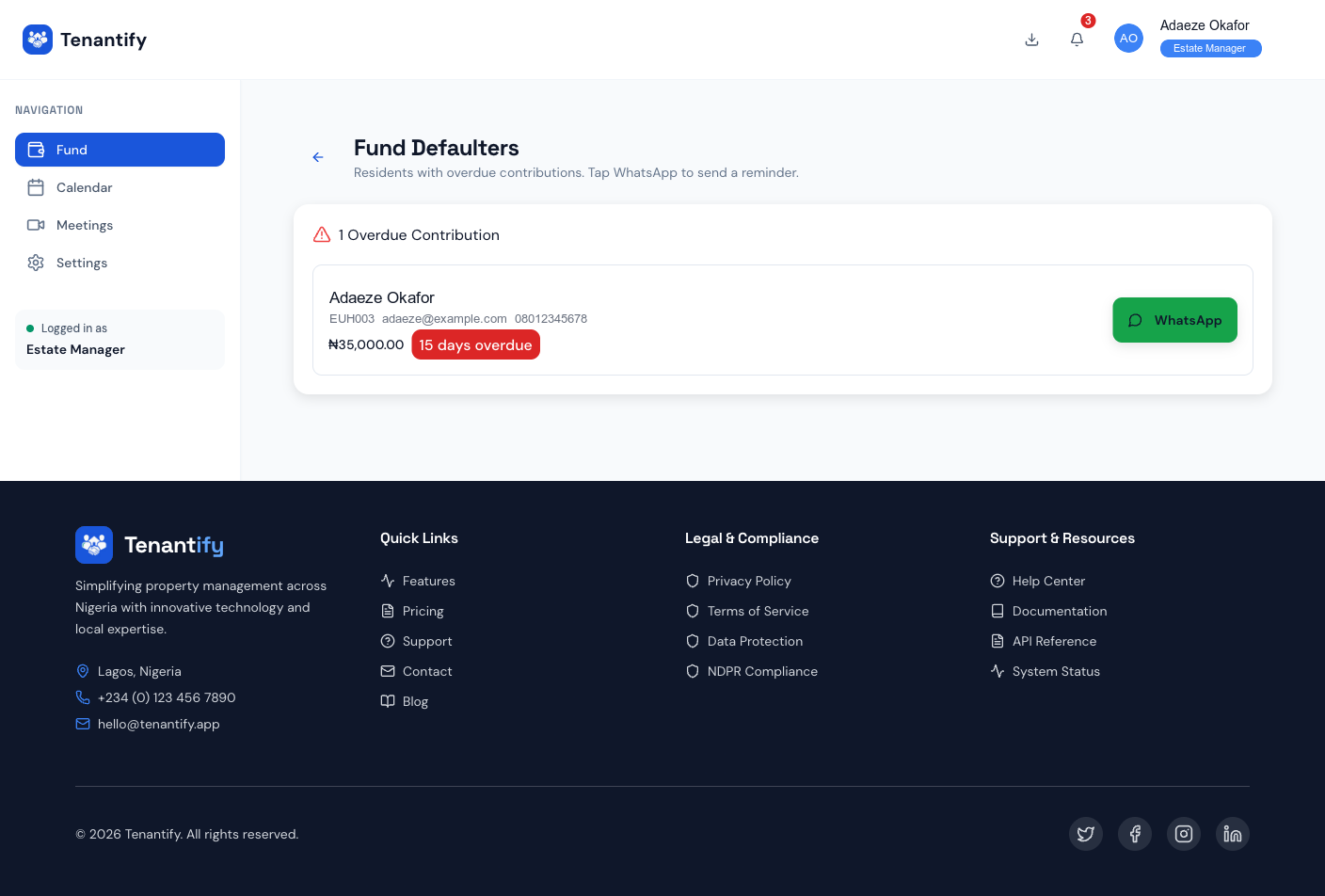
If no residents are overdue, the page shows a green checkmark card with “All residents are up to date”.
2. Pick the reminder channel
Each card has one of two buttons depending on which contact details Tenantify has:
- WhatsApp (green) — opens WhatsApp with a pre-filled message naming the amount, the periods overdue, and a polite ask to pay or reach out.
- Email (blue) — opens your mail client with the subject “Overdue Fund Contribution” and a similar pre-filled body.
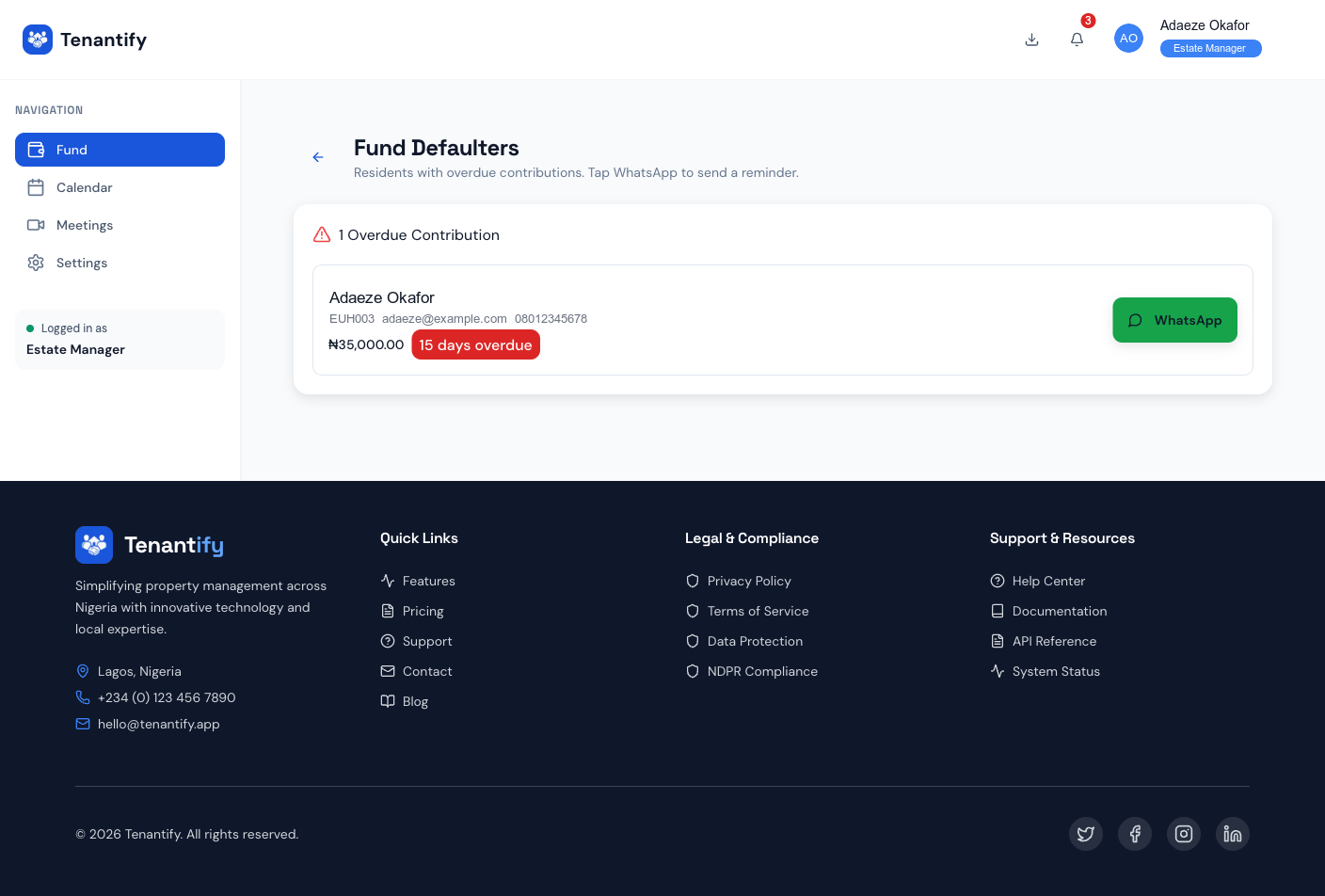
WhatsApp tends to convert faster in Nigerian estates because the resident sees the message immediately on a device they are already holding. Email is the formal backup.
3. Send the message
Click the button. The message is a starting point — feel free to edit it before sending. Some managers add a deadline; others soften the tone for long-time residents. Whatever you send, the resident sees their amount and overdue period in writing.
4. Follow up the next day if needed
Tenantify does not auto-escalate. You check back, you re-send, you call. The defaulter list updates the moment a payment clears, so a resident who paid earlier today drops off this list by the time you reopen it.
How the grace period interacts with the list
Each resident’s allocation has its own grace period (configurable at /fund/allocations). A resident with a 30-day grace stays off this list for the full month after a missed payment. If you want a shorter grace for a specific resident, override their allocation to a smaller value.
The defaulter status is per-resident across all periods — a resident overdue on two periods appears once, with the total summed.
If something goes wrong
WhatsApp button is missing. The resident has no phone number on file. Open /fund/residents, edit the resident, add a Nigerian phone number, save, return.
WhatsApp message opens to the wrong number. The phone field has a typo. Edit the resident’s record. The next visit to the defaulter page will use the corrected number.
Email button opens an empty Compose. Your operating system has no default email client configured. Either configure one (Outlook, Apple Mail, Gmail desktop) or copy the email shown in the card and paste it into your webmail.
Resident says they paid but they are still on the list. They may have paid via direct transfer to the estate’s bank, not through Tenantify. Tenantify only sees Paystack-routed payments. Direct transfers must be reconciled manually — for now, contact support.
The amount looks too high. A resident overdue on three periods owes three periods’ worth. The card sums them. Click the resident’s name (if surfaced) to open their full payment history.
What’s next
Most defaulters resolve within forty-eight hours of a WhatsApp reminder. For residents who do not respond, Configuring Allocations lets you adjust their grace period if the standard is genuinely too tight for them — or shorten it if you suspect chronic delay.